
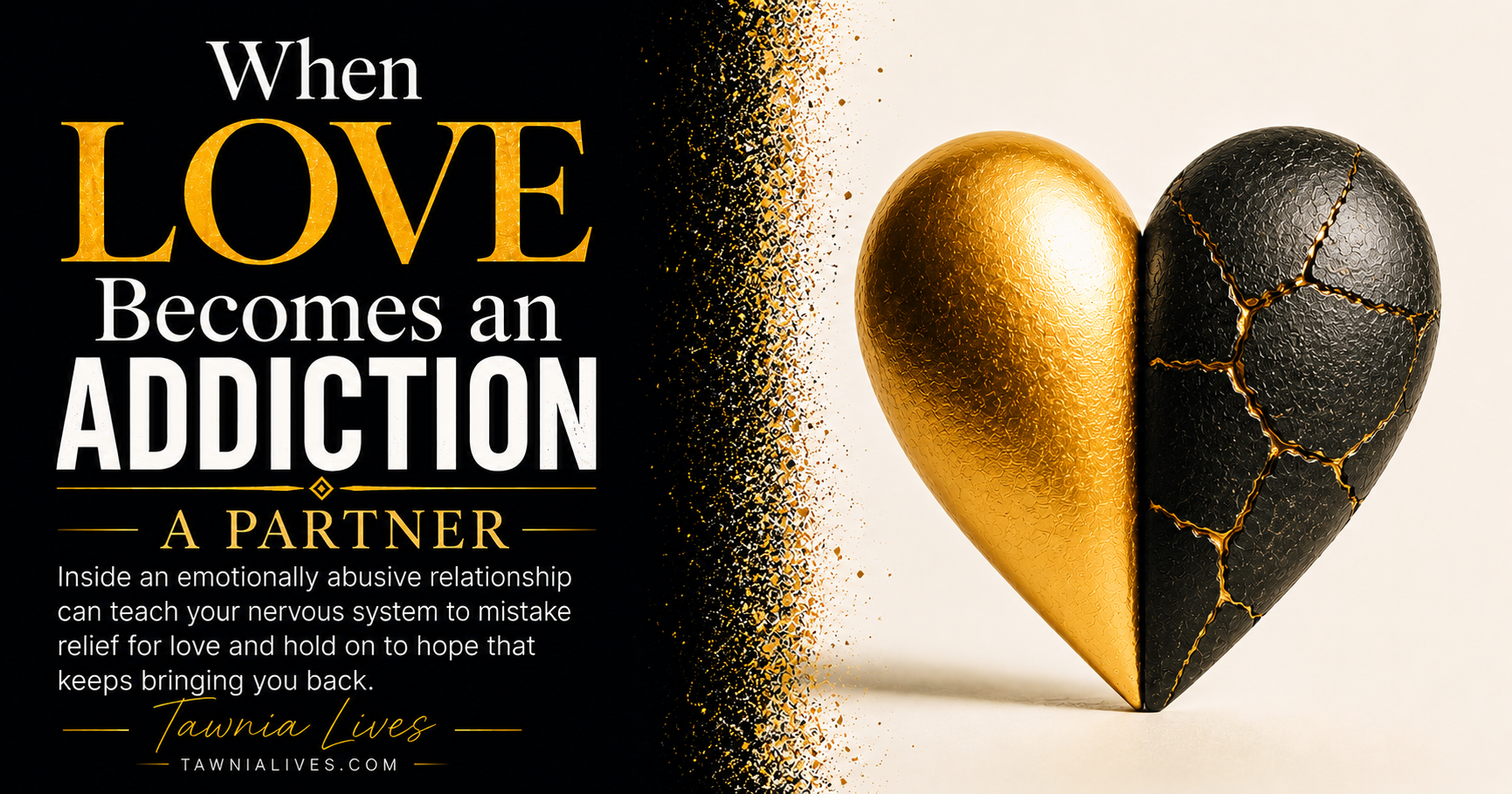
One of the quietest truths about surviving an emotionally abusive relationship
is how addictive the relationship itself can become.
Not because you’re addicted to abuse.
And not because you’re weak.
Because the same person who can leave you feeling completely broken
can also make you feel like you’re the most important person in the world…
sometimes within minutes.
Your nervous system never knows which version of them it’s going to meet.
And over time,
that becomes the addiction.
It rarely starts that way.
In the beginning,
they’re attentive.
Interested.
Captivated by you.
You feel chosen.
Seen.
Safe.
You believe you’ve finally found someone who understands you.
Someone who sees the parts of you no one else ever noticed.
You begin imagining a future.
A life together.
A relationship where you can finally exhale.
Then something changes.
The warmth becomes conditional.
The affection becomes unpredictable.
The closeness disappears…
then suddenly returns.
One day,
they can’t imagine life without you.
The next,
they make you feel like you’re impossible to love.
At first,
you don’t understand what’s happening.
You think something must have changed.
Maybe they’re stressed.
Maybe they’re overwhelmed.
Maybe I misunderstood.
Maybe I said it wrong.
Maybe I should explain it differently.
Maybe if I’m just a little more patient…
a little more understanding…
a little more loving…
we can get back to where we were.
So you adapt.
Not because you’re weak.
Because that’s what people do when they’re trying to save a relationship.
You start paying attention to everything.
Your tone.
Your timing.
Your words.
Their facial expressions.
Their moods.
The silence.
The distance.
You replay conversations in your head.
You rewrite text messages before you send them.
You begin organizing yourself around avoiding the next conflict.
Not because that’s who you are.
Because that’s how you’ve learned to survive.
Little by little,
your world gets smaller.
You stop sharing things with people because it’s exhausting trying to explain what’s happening.
You stop trusting your own instincts because you’ve been told you’re overreacting.
You stop believing your own memory because every disagreement somehow becomes your fault.
Without realizing it,
they slowly become the center of your emotional world.
The person who hurts you.
The person who comforts you.
The person who rejects you.
The person who makes you feel chosen again.
The same person who dysregulates your nervous system
becomes the only person your nervous system believes can regulate it again.
That’s what makes it so confusing.
One compliment
can feel like it carries the weight of a hundred.
Not because it was extraordinary.
Because you’ve been emotionally starving.
The contrast is so powerful
that one small moment of warmth
feels bigger than it really is.
A hug.
A smile.
A quiet evening.
An apology.
A simple,
“I love you.”
For a little while,
everything stops.
The fear.
The confusion.
The waiting.
Your body finally exhales.
You aren’t chasing the relationship.
You’re chasing the feeling
that everything is okay again.
Then it disappears.
And you’re right back where you started.
Trying to understand.
Trying to fix it.
Trying to find your way back.
That is the part many people never see.
You aren’t addicted to another person.
You’re addicted to what happens
when the pain finally stops.
You begin thirsting for their affection,
not because affection itself is enough,
but because every small moment of kindness
feels like confirmation
that maybe the relationship is still there.
Maybe they still love you.
Maybe everything is going to be okay.
So you hold on.
Not because the relationship is healthy.
Because your nervous system has learned
that relief only comes
from the same place the pain came from.
Then something else begins to happen.
The moment you start seeing the pattern…
The moment you stop accepting the blame…
The moment you begin standing up for yourself…
the warmth disappears.
The distance grows.
The punishments become colder.
The rejection becomes sharper.
And suddenly,
you find yourself wanting nothing more
than for things to go back
to the way they were yesterday.
Not because yesterday was healthy.
Because yesterday hurt less than today.
That is how the cycle protects itself.
It keeps moving the finish line.
Always convincing you
that peace is just one more conversation away.
One more apology away.
One more compromise away.
Until one day,
you finally realize
you were never chasing love.
You were chasing relief.
But slowly,
sometimes painfully,
a different truth begins to emerge.
Love was never supposed to leave you
desperately waiting
for the next moment
you were allowed to feel safe.
The moment you can finally name it,
something begins to change.
You stop chasing relief.
You begin looking for consistency.
You stop measuring love
by how incredible it feels
when the suffering finally pauses.
You begin realizing
that peace
and relief
are not the same thing.
One comes after suffering.
The other never required it.
— Tawnia Lives

This companion reflection expands on this featured reflection, offering another perspective on the same experience.